Facial care
Taking care of your face is one of those things that seems complicated until someone finally explains it clearly. Between serums, cleansers, exfoliants, masks and a dozen conflicting pieces of advice online, it is easy to feel lost. The truth is that facial care rests on a handful of simple principles, and once you understand them, choosing products and building a routine becomes far less intimidating.
This category brings together everything you need to care for your facial skin: understanding your skin type, building a routine that actually works, choosing the right products, and avoiding the mistakes that waste money or irritate your skin.
What Is Facial Care and Why Does It Matter?
Facial care covers all the habits and products used to keep the skin of your face clean, hydrated, balanced and protected. The skin on your face is thinner and more exposed than the skin on the rest of your body. It faces sunlight, pollution, temperature changes, makeup and friction every single day. Over time, these factors contribute to dryness, breakouts, sensitivity and visible signs of aging.
Good facial care is not about achieving perfection or following a ten-step ritual. It is about consistency. A simple routine performed daily will always beat an elaborate routine performed occasionally. Think of it like brushing your teeth: the value comes from repetition, not intensity.
Know Your Skin Type First
Before buying anything, it helps to identify your skin type. Everything else, from cleanser texture to moisturizer consistency, flows from this single observation.
- Normal skin feels comfortable overall, with no significant tightness or shine.
- Dry skin feels tight, sometimes flaky, especially after cleansing.
- Oily skin shines quickly, particularly in the T-zone (forehead, nose, chin), and is more prone to blackheads.
- Combination skin is oily in the center of the face and normal or dry on the cheeks.
- Sensitive skin reacts easily to products, heat or friction with redness, tingling or discomfort.
A simple test: wash your face with a gentle cleanser, wait an hour without applying anything, and observe. Tightness suggests dryness, shine suggests oiliness, and both at once suggests combination skin. If your skin stings or flushes easily in general, treat it as sensitive regardless of type.
Keep in mind that skin type is not fixed. Seasons, stress, hormones and age all shift the balance. Someone imagine a reader named Claire, who had oily skin as a teenager and now experiences dry cheeks in winter. Her routine had to evolve, and that is completely normal.
The Core Routine: Three Steps That Do Most of the Work
If you remember nothing else from this category, remember this trio. Almost every effective facial care routine, from the simplest to the most sophisticated, is built on these foundations.
1. Cleansing
Cleansing removes dirt, excess oil, sweat, pollution particles and makeup. Without clean skin, the products applied afterward cannot work properly. Choose a gentle cleanser that does not leave your face feeling tight or squeaky, that sensation usually means the cleanser has stripped your skin barrier. For makeup wearers, a double cleanse in the evening (first an oil-based cleanser or micellar water, then a regular cleanser) is a reliable approach.
2. Moisturizing
Moisturizer is not just for dry skin. Every skin type benefits from hydration, because a well-hydrated skin barrier is more resilient, less prone to irritation and better at regulating oil production. Oily skin types often skip this step and end up in a vicious cycle: dehydrated skin produces more oil to compensate. Lightweight gels and lotions suit oily skin; richer creams suit dry skin.
3. Sun Protection
If there is one product with proven, measurable long-term benefits, it is sunscreen. UV exposure is the primary external cause of premature skin aging and a major factor in pigmentation issues. Applying a broad-spectrum SPF every morning, even on cloudy days or when staying indoors near windows, is the single highest-impact habit in facial care.
- Cleanse your face (morning and evening).
- Apply moisturizer suited to your skin type.
- Finish with sunscreen in the morning as the final step.
Everything else is optional refinement built on top of this base.
Going Further: Targeted Treatments and Actives
Once the basics are in place, you can add targeted products for specific concerns. This is where facial care becomes more personal.
- Exfoliation removes dead skin cells for a smoother, brighter complexion. Chemical exfoliants (like AHAs and BHAs) are generally gentler and more even than harsh physical scrubs. Once or twice a week is plenty for most people.
- Serums deliver concentrated active ingredients. Vitamin C is popular in the morning for radiance and antioxidant protection; niacinamide helps with redness, oiliness and uneven tone; hyaluronic acid adds a hydration boost.
- Retinoids support skin renewal and are widely recommended for texture, breakouts and signs of aging. They require a slow introduction: start with a low concentration, apply a couple of evenings per week, and always pair with sunscreen.
- Eye creams and masks address specific zones or moments, such as puffiness, dehydration or a pre-event glow. Pleasant, but never a substitute for the core routine.
The golden rule with actives: introduce one product at a time, and wait two to four weeks before judging results or adding another. Skin needs time to adapt, and adding several new products at once makes it impossible to identify what works or what causes irritation.
Choosing Products Without Falling for Marketing
The beauty shelves are crowded and noisy. A few principles help you navigate without overspending.
- Read the ingredient list, not the front label. Terms like « clean, » « natural » or « anti-aging » are marketing language, not regulated definitions.
- Price does not equal effectiveness. Many affordable products are formulated excellently; many expensive ones rely on packaging and prestige.
- Fragrance-free options are a safer starting point for sensitive or reactive skin.
- Buy for your skin type and your actual concerns, not for a trend. A product loved by someone with oily skin may not suit dry skin at all.
It is also worth resisting the urge to replace everything at once. Replace products as they run out, one by one, so your skin (and your wallet) adapts gradually.
Common Mistakes to Avoid
Most facial care frustrations come from a handful of repeated errors:
- Over-cleansing or over-exfoliating, which damages the skin barrier and causes the very problems you are trying to fix.
- Skipping sunscreen, which quietly undoes the benefits of everything else you do.
- Switching products too fast, before they have had time to show results.
- Copying someone else’s routine without considering your own skin type and concerns.
- Picking at blemishes, which worsens inflammation and can leave marks.
If your skin becomes red, stinging or constantly dry, the best move is usually to strip your routine back to the three essentials and let the barrier recover before reintroducing anything.
When to See a Professional
Home care covers a lot, but it has limits. Persistent acne, sudden changes in your skin, suspicious moles or spots, and conditions like rosacea or eczema deserve a dermatologist’s attention. A professional can also help you prioritize, which saves both time and money in the long run. Facial care and medical care are not opposites; they work best together.
Explore the Facial Care Category
The articles in this section go deeper into each of these pillars: detailed comparisons of cleansers and moisturizers, how to use active ingredients safely, routines adapted to each skin type and season, and honest answers to the questions readers ask most. Start with your skin type, build your three-step base, and explore from there, your skin will thank you for the consistency long before it thanks you for the complexity.

Why Do Mild Acids Sometimes Cause More Breakouts in the First 2 Weeks ?
A mild exfoliating acid should make skin feel smoother, not leave it covered in unexpected spots. Yet some people notice small bumps, redness or increased breakouts shortly after introducing lactic acid, mandelic acid or a polyhydroxy acid (PHA). The reaction…
Lire la suite
Why Do You Own 5 Serums but Still See No Change After 30 Days ?
Owning five serums does not mean your skin is receiving five times the benefit. If your complexion looks unchanged after 30 days, the problem may be a mismatched active ingredient, an irritating cleansing routine, overlapping products or simply too little…
Lire la suite
Why Do Enzyme Peels Feel Gentle but Still Cause Redness the Next Day ?
An enzyme peel can feel surprisingly comfortable while it is on your face, then leave your cheeks red, tight or unusually sensitive the following morning. This apparent contradiction is particularly frustrating when you have chosen enzymes because conventional exfoliating acids…
Lire la suite
Why Does Your Skin Feel “Paper-Dry” Even When It Looks Fine ?
Your complexion looks perfectly ordinary in the mirror. There is no obvious redness, cracking or peeling. Yet when you smile, touch your cheek or apply foundation, your skin feels strangely stiff, almost like thin paper. That uncomfortable sensation can happen…
Lire la suite
Why Does Your Skin Still Feel Gritty After Cleansing at Night ?
Your face has been washed, rinsed and dried, yet running your fingertips over your cheeks or nose still reveals a sandy, uneven texture. The immediate temptation is to cleanse again, reach for a scrub or use hotter water. Unfortunately, none…
Lire la suite
Why Does an Oil Cleanser Sometimes Make Skin Feel Drier Than a Gel Wash ?
An oil cleanser can leave skin feeling drier than a gel wash because its oily texture does not determine how gently it cleanses. The emulsifying ingredients, contact time, rinsing technique and any second cleanser all influence the result. A product…
Lire la suite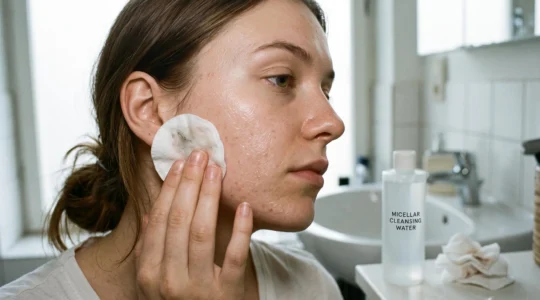
Why Does Micellar Water Leave Your Skin Feeling Sticky After Cleansing ?
Micellar water can leave skin feeling sticky because cleansing ingredients, moisturising components or material lifted from the skin may remain on its surface after wiping. Sunscreen, makeup and excess sebum can make that sensation more noticeable, especially when one cleansing…
Lire la suite