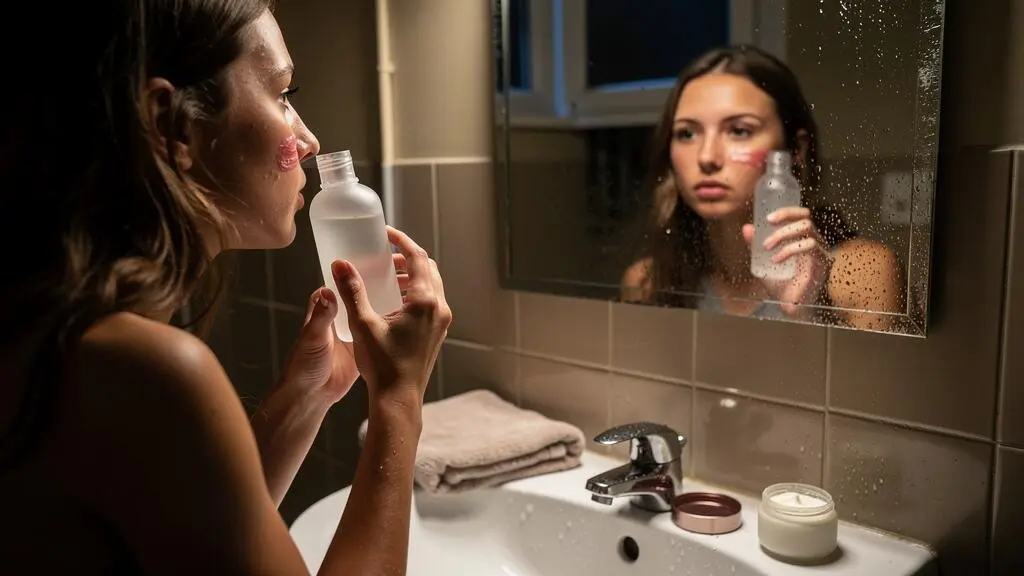
A mild exfoliating acid should make skin feel smoother, not leave it covered in unexpected spots. Yet some people notice small bumps, redness or increased breakouts shortly after introducing lactic acid, mandelic acid or a polyhydroxy acid (PHA). The reaction can be confusing, particularly when the product promises gentle exfoliation.
New spots during the first two weeks do not automatically mean that an acid is working. Exfoliating treatments may contribute to changes in existing clogged pores, but they can also cause irritation, dryness or acne flare-ups. These reactions can look similar while requiring very different responses.
The safest approach is to consider where the spots appear, whether the skin stings or feels tight, how often the acid is applied and which other products are being used. A simple routine, gradual introduction and careful observation are more useful than pushing through discomfort in the hope that skin will eventually adjust.
Mild acids and early breakouts: what matters most
- A low acid percentage does not guarantee low irritation: formulation, pH, skin condition and application frequency all matter.
- Breakouts accompanied by burning, persistent redness or tightness are warning signs of irritation, not evidence that exfoliation is working.
- Start with one exfoliant, use it conservatively and prioritise moisturising and daily sun protection.
- Why Can a Mild Acid Trigger Spots in Week 1 Even if It’s « Low Strength »?
- Is It Purging or Irritation: Which One Explains New Breakouts in the First 10 Days?
- Why Does Your Skin Look Duller After You Start Exfoliating More Often?
- How to Start Exfoliation If You’re a Beginner Without Damaging Your Skin?
- How to Introduce a Mild Acid Twice a Week Without Burning or Peeling?
- PHA, Lactic, or Mandelic: Which Mild Acid Fits Sensitive Skin With Texture?
- The Mistake of Mixing Acids With Fragrance-Heavy Products That Worsens Stinging
- When Should You Use Mild Acids if You Shave or Wax Weekly to Avoid Sting?
Why Can a Mild Acid Trigger Spots in Week 1 Even if It’s « Low Strength »?
A mild acid can trigger spots during the first week because even a relatively gentle exfoliating formula may irritate sensitive skin or aggravate an already weakened skin barrier. Changes in existing clogged pores are another possible explanation, but a breakout cannot reliably be labelled purging simply because it starts after exfoliation.
The phrase « low strength » usually describes a product’s concentration or intended gentleness. It does not establish how strongly the finished formula will affect the skin. Lactic acid and PHAs can still exfoliate, and their effects depend on more than the percentage printed on the packaging.
According to the FDA information on alpha hydroxy acids, exfoliation depends on the acid type, concentration, pH and other formulation ingredients. The FDA also describes research in which an AHA penetrated more deeply from a cosmetic cream base than from a simpler solution. A toner is therefore not automatically stronger than a cream, or vice versa.
Concentration and pH describe different properties. Concentration indicates how much acid is present, while pH helps determine the chemical environment in which it acts. The acid’s pKa also affects its ionisation at a given pH. A hypothetical comparison between 5% glycolic acid at pH 3.5 and 10% lactic acid at pH 4.5 illustrates why percentages alone are inadequate, but those numbers cannot establish which finished product would be more irritating without formulation-specific evidence.
Existing barrier damage makes the situation less predictable. Skin affected by harsh cleansing, frequent exfoliation or other irritating treatments may already be dry and reactive. Introducing another exfoliant can then produce redness and inflamed bumps rather than the smoother texture expected.
- Previously comfortable skin: note where spots appear and whether there are any additional irritation symptoms.
- Already tight or flaky skin: prioritise barrier recovery before introducing another exfoliant.
- Stinging or worsening redness: stop using the acid rather than increasing its frequency.
The next distinction is more important than the strength label: whether the new blemishes resemble an acne flare or a reaction to the product itself.
Is It Purging or Irritation: Which One Explains New Breakouts in the First 10 Days?
Purging is a possible explanation when new blemishes appear in areas already prone to clogged pores after starting a treatment that affects skin-cell turnover. Irritation is more concerning when spots are accompanied by stinging, redness, itching or tightness. Neither the appearance of spots nor the first ten days alone can confirm the cause.
Skin purging is commonly used to describe the apparent acceleration of pre-existing clogged pores becoming visible. However, the evidence available for ordinary mild-acid routines does not establish a universal purging period or a reliable ten-day diagnostic rule.
Irritation has a different practical implication. Excessive exfoliation can contribute to dryness, redness and acne breakouts, as explained in the American Academy of Dermatology recommendations for safe exfoliation.
Rather than trying to diagnose the reaction by timing alone, compare several observations.
| Observation | Possible purging | Possible irritation |
|---|---|---|
| Where spots appear | Areas with an established history of clogged pores | Areas that were previously clear, or wherever the product was applied |
| Associated sensations | May occur without unusual discomfort | Stinging, burning, itching or tightness may accompany bumps |
| Response to repeated use | May fluctuate as existing lesions emerge | Redness or discomfort may become more noticeable |
| Effect of reducing exposure | Changes may be difficult to interpret | Improvement after stopping can support suspicion of a product-related reaction |
| Diagnostic certainty | Cannot be confirmed by location or timing alone | Symptoms raise concern but do not identify the exact cause |
A mixed reaction is possible. Someone may have pre-existing comedones and develop irritation after introducing an acid. In that situation, burning and persistent redness deserve priority over a theory that the skin is simply purging.
For a new product, a small-area tolerance test can help identify obvious reactivity before widespread application. Follow the manufacturer’s directions and avoid repeatedly challenging skin that is already irritated. Applying a product to one side of the jaw does not produce a clinically validated diagnosis: a localised reaction may suggest product involvement, while spreading symptoms require broader assessment.
Keep a brief record of the application date, affected areas, discomfort and visible changes. This is more informative than assuming that all blemishes appearing within ten days share the same cause.
When burning, swelling, marked inflammation or persistent worsening occurs, discontinue the suspected product and seek professional advice. Even without obvious spots, barrier stress can show up in another unexpected way: dull-looking skin.
Why Does Your Skin Look Duller After You Start Exfoliating More Often?
Skin may look duller after more frequent exfoliation because irritation and dehydration can make its surface appear dry, rough or flaky. Exfoliation removes surface cells, but using acids too aggressively can leave skin less comfortable and less even-looking. More exfoliation is not necessarily the solution to a temporary loss of radiance.
The apparent contradiction comes from confusing exfoliation with hydration. Removing surface cells may improve texture when the process is well tolerated. But if frequent acid use aggravates dryness, fine flakes and rough patches can become more visible.
Healthy skin relies on its outer barrier to maintain moisture and limit exposure to irritants. Disrupting that balance can contribute to a surface that feels tight or looks uneven. Dehydration and changes in surface texture may affect how light reflects from the skin, although dullness alone cannot establish that lipid depletion or barrier damage has occurred.
The temptation is to increase exfoliation because the first applications have not produced obvious brightness. This can create a counterproductive cycle: more acid, more discomfort, and further attempts to exfoliate away the resulting roughness.
Consider the accompanying signs before deciding what the skin needs:
- Dullness with tightness or stinging: irritation or dryness is more plausible, particularly after increasing frequency.
- Flaking after a recent acid application: do not assume that loose-looking skin needs another exfoliating treatment.
- Persistent roughness without discomfort: review the product, routine and underlying skin concern rather than automatically using a stronger acid.
- Redness that persists or sensitivity to ordinary cleansing: stop the exfoliant and reassess the routine.
For suspected over-exfoliation, temporarily remove the acid and focus on a gentle cleanser, an appropriate moisturiser and sun protection. A bland, fragrance-free moisturiser can help reduce unnecessary irritation from additional ingredients.
There is no universal recovery timetable. The duration depends on the reaction and any underlying skin condition. If discomfort persists despite simplifying the routine, a pharmacist, GP or dermatologist can help identify the cause.
A more reliable route to smoother-looking skin begins with a manageable starting routine rather than trying to produce visible peeling.
How to Start Exfoliation If You’re a Beginner Without Damaging Your Skin?
Beginners should start with one mild exfoliating product, use it sparingly and build the surrounding routine around gentle cleansing, moisturising and sun protection. Choose a formulation suited to the skin’s sensitivity rather than selecting the highest available concentration. Persistent stinging, redness or peeling means the routine needs reassessment, not greater intensity.
First identify the skin concern. Dry, rough skin may need improved moisturising more than exfoliation. Repeated clogged pores may call for a different approach from occasional surface unevenness. If skin is already inflamed, cracked or particularly reactive, postponing exfoliation is sensible.
A PHA or a carefully formulated low-strength lactic acid product may be worth considering for a cautious introduction. Neither category guarantees tolerance. Assess the complete ingredient list, product directions, concentration where disclosed and the presence of additional exfoliants.
For a leave-on product, apply it as directed, usually to clean, dry skin, and follow with moisturiser according to the manufacturer’s instructions. There is no established need for a universal waiting period before moisturising. Applying moisturiser first may be tolerated with some routines, but it should not be treated as a reliable way to calculate or control the effective acid dose.
Keep other active treatments unchanged while introducing the new product. Retinoids, benzoyl peroxide and additional exfoliants can increase dryness or irritation when combined with exfoliation. Strong vitamin C formulations may also sting sensitive skin, depending on their ingredients and acidity, but vitamin C products are not all equivalent.
Your five-step beginner exfoliation checklist
- Record the starting condition. Note baseline dryness, existing blemishes and sensitive areas; keep a short skin-condition record.
- Choose one acid product. Write down its acid type, stated concentration, full product name and usage instructions.
- Plan limited exposure. Mark the intended application dates in a calendar, avoiding other exfoliating treatments on those occasions.
- Monitor the response. Log each application, any stinging or redness, and changes visible the following day.
- Review before adjusting. Compare the notes after several applications and document whether to maintain, reduce or stop use.
The log does not need to be complicated. A dated note on a phone is sufficient. Its value lies in identifying changes after individual applications rather than relying on an impression that the skin has suddenly become worse.
Avoid exfoliating over open cuts, sunburn or visibly damaged skin. During the day, use suitable broad-spectrum sun protection; exfoliating AHAs can increase sensitivity to ultraviolet exposure.
Once one product is reasonably well tolerated, a structured weekly schedule makes it easier to avoid the common mistake of applying too much too soon.
How to Introduce a Mild Acid Twice a Week Without Burning or Peeling?
To introduce a mild acid twice a week, choose non-consecutive application days, use the product according to its directions and moisturise afterwards. Begin with a lower frequency if your skin is particularly reactive. Skip further applications when tightness, burning, persistent redness or peeling develops. Twice weekly is a practical starting option, not a universally safe prescription.
For example, Tuesday and Friday evenings create a gap between applications. A person with sensitive skin might instead begin with one weekly application and reassess before adding another. The ideal frequency depends on the acid, its formulation, the skin’s condition and other treatments in use.
On an application evening, use a gentle cleanser and avoid unnecessary scrubbing. Allow the skin to dry before applying a leave-on product if its instructions recommend this. Use the recommended amount rather than layering additional acid to accelerate results, and finish with a suitable moisturiser.
On the intervening days, concentrate on basic skin care. A straightforward routine makes it easier to identify whether the exfoliant is responsible for an unwanted reaction.
| Day | Evening routine | What to check |
|---|---|---|
| Monday | Cleanser and moisturiser | Baseline comfort |
| Tuesday | Mild acid and moisturiser | Immediate stinging or redness |
| Wednesday | Moisturiser-focused routine | Delayed irritation or dryness |
| Thursday | Gentle routine | Whether skin feels normal |
| Friday | Second acid application, only if comfortable | Reaction compared with Tuesday |
| Weekend | Gentle routine without exfoliation | Overall tolerance |
This example assumes there is no conflicting product guidance, active skin irritation or recent hair-removal procedure affecting the treatment area.
Do not use the absence of peeling or tingling as evidence that the acid is ineffective. Visible irritation is not a necessary part of exfoliation. Similarly, a lack of dramatic improvement after a few applications does not justify immediately switching to a stronger formula.
If skin remains comfortable but results are limited, first consider whether the product is suitable for the concern and whether it has been used consistently for a reasonable period. An additional application may be appropriate for some products, but increasing frequency before concentration is not an evidence-based rule that applies universally. Follow the label and avoid exceeding its directions.
Audit the rest of the routine before making changes. Harsh or high-pH cleansers, drying astringent toners and overlapping exfoliants can make an otherwise manageable schedule uncomfortable. A cleanser’s pH alone, however, cannot establish how much stinging it will cause.
The next decision is which acid is most appropriate, since the differences between PHAs, lactic acid and mandelic acid are not captured by the word « gentle ».
PHA, Lactic, or Mandelic: Which Mild Acid Fits Sensitive Skin With Texture?
PHAs, lactic acid and mandelic acid may all be suitable for addressing uneven texture, but they differ in chemical structure, formulation possibilities and skin-care applications. PHAs and lactic acid are reasonable options to investigate when dryness accompanies roughness. Mandelic acid may appeal to people concerned about clogged pores, although no acid type is universally best for sensitive skin.
PHAs such as gluconolactone are often positioned as gentle exfoliants. Their molecular characteristics differ from those of smaller AHAs, but molecular size alone cannot predict a product’s penetration, strength or likelihood of irritation.
Lactic acid is an AHA used in exfoliating formulas and is also associated with moisturising properties in skin care. A low-strength lactic acid formula may be useful for surface roughness, provided the finished product is well tolerated.
Mandelic acid is an aromatic AHA often promoted for acne-prone or oily skin. Its chemical characteristics can influence formulation and skin interaction, but broad claims that it reliably reduces pore size or post-acne texture better than PHAs or lactic acid require direct comparative evidence.
A clinical study of hydroxy acids and skin barrier function illustrates why acid selection cannot be reduced to a single gentleness ranking. In a small randomised study involving eleven healthy participants, researchers compared 8% formulations of several hydroxy acids. They observed differences in skin responses to a controlled irritation challenge, including findings favourable to gluconolactone-treated sites. The study did not directly compare mandelic acid or establish how commercial products perform on acne-prone facial skin.
The following table provides practical selection considerations rather than a clinical ranking of effectiveness.
| Criterion | PHA | Lactic acid | Mandelic acid |
|---|---|---|---|
| Common example | Gluconolactone | Lactic acid | Mandelic acid |
| Chemical characteristics | Multiple hydroxyl groups; relatively large molecular structure | Small AHA molecule | Aromatic AHA with a larger molecular structure than lactic acid |
| Texture concern to investigate | Dryness-associated roughness | Surface roughness and uneven texture | Uneven texture with clogged pores |
| Moisturising considerations | Frequently formulated with hydration-focused ingredients | Can be incorporated into moisturising exfoliating products | Hydration depends substantially on the complete formula |
| Sensitivity considerations | May be well tolerated, but not automatically irritation-free | Activity depends on concentration, pH and vehicle | Tolerability depends on the full formula, not molecular size alone |
| Product pH | No universal pH across products | No universal pH across products | No universal pH across products |
For sensitive skin with roughness and dryness, it may be sensible to investigate a simple PHA formula or a modest-strength lactic acid product. For texture associated with clogged pores, mandelic acid is another option, but recurrent acne may warrant assessment and treatments with stronger evidence for that specific condition.
Before purchase, check the ingredient list for additional exfoliants, fragrance and other potentially irritating components. Consider the recommended frequency, the manufacturer’s directions and any disclosed information about concentration or finished-formula pH. These details are more useful than an unsupported promise that a product is suitable for every sensitive skin type.
Alternating lactic acid and mandelic acid on different days may sound like a way to address dryness and oily areas simultaneously. However, using two formulas introduces additional variables and does not automatically reduce total exfoliating exposure. Beginners should establish tolerance to one product before considering any combination, particularly when sensitivity is the main concern.
Choosing an appropriate acid is only part of the process. Other ingredients in the same routine can determine whether the experience remains comfortable.
The Mistake of Mixing Acids With Fragrance-Heavy Products That Worsens Stinging
Combining exfoliating acids with fragrance-heavy skincare can make a routine harder to tolerate, particularly for people who are sensitive to fragrance or already experiencing irritation. Fragrance is a recognised contact-dermatitis trigger, while exfoliation can independently cause dryness and stinging. Their combined use deserves caution, although the precise interaction depends on the ingredients and individual skin response.
A common scenario involves applying an acid toner, following it with a heavily fragranced serum and finishing with a scented cream. If the skin subsequently stings, it may be difficult to identify which product or combination caused the discomfort.
Fragrance compounds can provoke irritant or allergic reactions in susceptible individuals. The presence of an acid does not prove that fragrance allergens penetrated more deeply, and available evidence does not support a universal numerical increase in irritation caused by combining the two.
The American Academy of Dermatology identifies fragrance as a common contact-dermatitis trigger and recommends fragrance-free products when fragrance sensitivity is a concern. It also distinguishes fragrance-free from unscented: products described as unscented can still contain fragrance ingredients intended to mask other odours.
On exfoliation days, simplify the routine by removing unnecessary scented serums, masks and aftershaves. Look for fragrance-free options when appropriate, and review the ingredient list rather than relying exclusively on the front label.
Ingredients worth checking include parfum or fragrance, essential oils, aromatic botanical extracts, menthol and alcohol denat. These ingredients do not all have identical effects, and their presence does not prove that a product will irritate everyone. The priority is recognising ingredients that may cause problems for your own skin.
If a scented product is important to your routine, avoid introducing it at the same time as a new exfoliant. Separating product changes makes reactions easier to interpret, although using a known allergen on another day is not a reliable way to prevent allergic contact dermatitis.
Stinging is not a measure of exfoliating effectiveness. Brief sensations can have different explanations, but burning that persists, visible inflammation or discomfort that increases with each application should not be ignored. Stop the suspected product and assess the reaction rather than attempting to build tolerance through repeated exposure.
This same principle of avoiding overlapping irritation becomes especially important when shaving or waxing removes or disturbs the skin’s outermost surface.
Key takeaways before planning exfoliation around hair removal
- Judge skin readiness by the condition of the treatment area, not simply by the number of days since the last acid application.
- Shaving and waxing can make an area temporarily more reactive, so exfoliation should not be layered onto visibly irritated skin.
- Skin that is red, tender or damaged needs recovery and moisturising before another active treatment.
When Should You Use Mild Acids if You Shave or Wax Weekly to Avoid Sting?
Use mild exfoliating acids on days separated from shaving or waxing, and only when the treated skin feels comfortable and shows no signs of irritation. Shaving can disturb the superficial skin barrier, while waxing may remove superficial skin cells as well as hair. Waxed or irritated areas may need a longer acid-free interval before exfoliation resumes.
Hair removal and chemical exfoliation affect the skin in different ways, but combining them too closely can increase discomfort. A razor can produce friction, microscopic surface disruption and post-shave redness. Applying an acid immediately afterwards may make an already sensitive area sting.
Waxing can be more disruptive in some circumstances because adhesion and removal of the wax can affect superficial skin as well as hair. The reaction depends on the wax, technique, treated area and individual skin condition.
There is no single clinically established waiting interval that is appropriate for every shave, wax and mild-acid formulation. Product instructions and advice from the hair-removal provider should take priority, particularly after waxing.
For someone shaving on Monday, a hypothetical low-exposure schedule could reserve Tuesday for moisturising and consider an acid later in the week only if redness and tenderness have resolved. If the skin is not fully comfortable, skip that week’s exfoliation rather than trying to preserve a fixed twice-weekly target.
After waxing, a more conservative interval is appropriate, especially when the area remains tender. Do not apply acid to skin that is inflamed, abraded, visibly damaged or recovering from a significant reaction.
Use a gentle cleanser and moisturiser after hair removal, avoiding unnecessary exfoliating products while the skin is recovering. Strongly scented aftershaves or other products that produce stinging can complicate the reaction and are best avoided on sensitive treated areas.
The location of hair removal also matters. Shaving the legs does not automatically prevent the use of a previously tolerated exfoliant on unaffected facial skin, provided the face itself is healthy and the product is appropriate. The concern is primarily local irritation, not a whole-body reaction caused by ordinary topical exfoliation.
If repeated shaving causes bumps, distinguish possible ingrown hairs or follicular inflammation from reactions to an exfoliant. Mild acids are not necessarily the correct treatment for every post-shave bump, and persistent or painful lesions merit professional assessment.
People using prescription retinoids or other treatments that affect skin sensitivity should also seek specific advice before waxing relevant areas, rather than assuming that an acid-free interval alone makes the procedure safe.
For the next hair-removal session, mark the date, allow the treated skin to recover and place any future acid application on a separate day. Keep the routine flexible: comfortable skin is a more meaningful goal than completing every scheduled exfoliation session.
Should you keep using an acid if small spots appear but your skin does not sting?
Not necessarily. The absence of stinging does not confirm purging or prove that the product is suitable. Review where the spots occur, whether existing acne is worsening and whether other products have changed. If breakouts continue or become more inflamed, stop the suspected product and seek advice rather than assuming the reaction is temporary.
Can a moisturiser prevent all irritation from exfoliating acids?
No. Moisturising helps support skin comfort and is recommended after exfoliation, but it cannot guarantee protection from an irritating concentration, unsuitable formulation or excessive application frequency. Persistent burning or redness is a reason to stop the acid rather than adding more moisturiser to compensate.
Does a higher acid percentage always give faster results?
No. The finished product’s activity depends on the acid type, concentration, pH and other formulation ingredients. Higher percentages do not guarantee better results and can increase tolerability concerns. Choose a product for the skin concern and follow its instructions rather than treating concentration as a performance ranking.
Can you use a mild exfoliating acid all year in the UK?
Potentially, if the product is appropriate and the skin tolerates it. However, UK weather does not eliminate ultraviolet exposure. AHAs can increase sun sensitivity, so suitable broad-spectrum sun protection remains important throughout the year, alongside avoiding use on sunburned or irritated skin.
When should a breakout after exfoliation be assessed by a healthcare professional?
Seek advice if the reaction is persistent, worsening, painful or difficult to distinguish from acne or contact dermatitis. Stop the suspected product if significant irritation develops. Severe swelling, blistering or symptoms suggesting a serious allergic reaction require prompt medical assessment; breathing difficulty or swelling affecting the airway is an emergency.