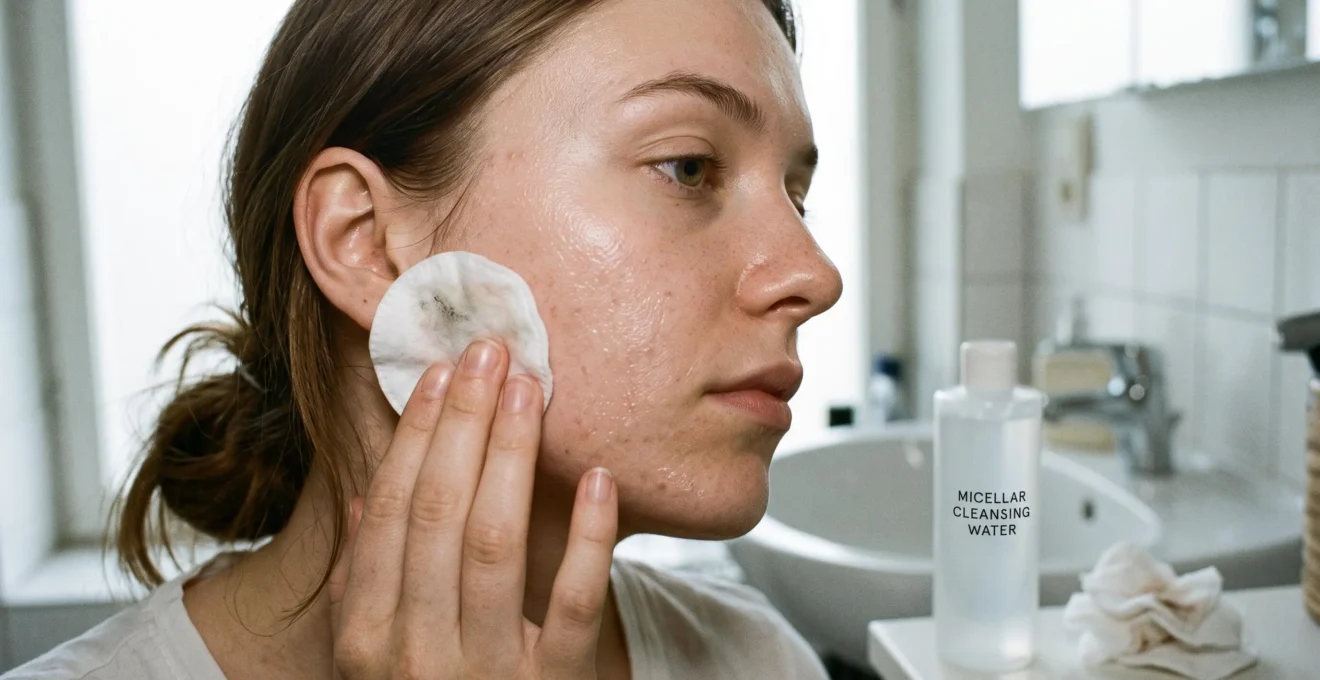
Micellar water can leave skin feeling sticky because cleansing ingredients, moisturising components or material lifted from the skin may remain on its surface after wiping. Sunscreen, makeup and excess sebum can make that sensation more noticeable, especially when one cleansing step does not remove everything. However, stickiness alone does not prove that pores are clogged or that a product is damaging the skin barrier.
For UK users who rely on micellar water for a quick evening cleanse, the most useful first step is to identify when the sensation occurs. Does it appear immediately after using a cotton pad? Does it persist after rinsing? Does the skin also feel tight, sting or develop small bumps? These differences can help distinguish a remaining product film from irritation or a cleanser that is not removing the day’s sunscreen effectively.
The practical solution is usually straightforward: use less friction, assess the sunscreen being removed, and rinse or follow with a gentle cleanser when necessary. Micellar water does not need to be abandoned simply because it feels sticky, but a no-rinse label should not prevent you from adjusting a routine that leaves your skin uncomfortable.
Micellar Water: The Essentials
- Sticky skin can indicate a remaining product film, but it can also reflect the formulation or skin irritation.
- Hold a saturated cotton pad briefly against the skin before wiping, and avoid repeated scrubbing.
- If stickiness persists, rinse with lukewarm water or use a gentle rinse-off cleanser suited to the sunscreen and your skin’s tolerance.
- Why Can Micellar Water Cause Breakouts Even if You Don’t Wear Makeup?
- How to Use Micellar Water After a Long Day Without Rubbing Your Skin Raw?
- Micellar Water or Face Wash: Which Is Better After Wearing SPF for 8 Hours?
- The No-Rinse Mistake That Makes Skin Feel Drier by Day 5
- When Should You Use Micellar Water in Your Routine to Avoid Over-Cleansing?
- Gel or Cream Cleanser: Which One Works Better After Wearing SPF All Day?
- Cleansing Balm or Cleansing Oil: Which Removes Stubborn SPF With Less Residue?
- Why Does an Oil Cleanser Sometimes Make Skin Feel Drier Than a Gel Wash?
Why Can Micellar Water Cause Breakouts Even if You Don’t Wear Makeup?
Micellar water can coincide with breakouts even when you do not wear makeup, because bare skin still accumulates sunscreen, sebum, sweat and environmental particles. If the formula leaves a film, or if cleansing does not adequately remove the day’s buildup, your skin may feel coated. However, there is no established evidence that micellar residue automatically clogs pores or directly causes acne in everyone.
Micellar water contains cleansing molecules called surfactants, which form structures known as micelles. These help lift oily material and dirt from the skin onto a cotton pad. Depending on the formula and how it is used, some ingredients may remain after wiping. Dermatology experts discussing cleanser chemistry have identified potential irritation from remaining ingredients, particularly in sensitive skin. The Dermatology Times discussion of cleanser science explains why residue and skin-barrier compatibility deserve attention.
Two different problems can look similar. Irritation is more likely when there is burning, stinging, redness or tightness, particularly after repeated wiping. Pore congestion may present as persistent small bumps or new spots, although these signs are not diagnostic and can have several causes. Friction-prone areas may be affected by rubbing, but the location of a breakout alone cannot identify its cause.
Not wearing makeup does not necessarily mean that a minimal cleanse is enough. A day spent wearing SPF, exercising or travelling through a polluted environment can leave material that needs to be removed. Conversely, using multiple cleansers when the skin is already irritated may worsen discomfort rather than improve cleanliness.
If your cotton pad looks clean but your face still feels tacky, treat that as a reason to reassess the method rather than proof of clogged pores. A gentle rinse or a suitable rinse-off cleanser can help establish whether the sensation comes from the micellar product itself.
The key is to look for a repeatable pattern rather than blame one ingredient without evidence. If acne persists, becomes painful or leaves scars, seek advice from a pharmacist, GP or dermatologist instead of repeatedly changing cleansing products.
How to Use Micellar Water After a Long Day Without Rubbing Your Skin Raw?
You can remove makeup and everyday grime with micellar water without scrubbing by allowing the saturated cotton pad to rest against the skin briefly before wiping. This gives the liquid time to loosen material, reducing the need for repeated passes. Use light pressure, choose a soft pad, and stop if the skin becomes sore, hot or visibly red.
Repeated wiping can irritate the skin regardless of whether the cleanser is labelled gentle. The American Academy of Dermatology Association recommends a mild, non-abrasive cleanser, fingertip application where appropriate, lukewarm water and careful drying. Its face-washing recommendations also caution against scrubbing because it can irritate the skin.
A practical technique is to start with the areas that need the most dissolving time. For eye makeup, keep the pad against the closed eyelid briefly, then wipe gently without dragging the skin. Use a separate clean pad for the other eye if needed. On the face, work in manageable areas with light strokes rather than repeatedly rubbing the same patch.
Once the first pass is complete, inspect the pad and decide whether a fresh one is needed. A new pad is preferable to scrubbing harder with a dirty one. There is no need to continue wiping until the cotton is perfectly white: some staining may persist, and repeated friction can cause more irritation than it prevents.
Pad texture also matters in practice. If a woven or quilted surface feels rough, switch to a smoother, softer option. Reusable pads may be suitable if they are clean, well maintained and gentle on your skin; a reusable product is not automatically less abrasive.
When skin feels persistently tight or sticky after this gentler technique, consider whether the formula needs rinsing or whether the cleansing method is too aggressive overall. The aim is effective removal with minimal mechanical stress, not a sensation of squeaky-clean skin.
A softer pad and fewer passes may be enough for light makeup and everyday grime. For stubborn sunscreen or waterproof cosmetics, however, choosing a more suitable first cleanser is often more useful than increasing the pressure.
Micellar Water or Face Wash: Which Is Better After Wearing SPF for 8 Hours?
After wearing SPF for eight hours, a rinse-off face wash may be more suitable than micellar water alone when the sunscreen is water-resistant, tinted or designed to form a durable film. Micellar water can lift surface oil and dirt, but it may not remove every sunscreen formulation in one pass. The right choice depends on the product worn, the cleansing formula and your skin’s tolerance.
Sunscreens are not all the same. Their UV filters, emollients, silicones and film-forming ingredients vary, and water-resistant formulas are designed to adhere to the skin under specified conditions. That makes it difficult to predict removal performance from the word SPF or the number of hours worn alone. A sunscreen worn all day is not necessarily harder to remove than every sunscreen worn for a shorter period.
Micellar water can be a convenient first step, particularly for lifting surface grime or loosening makeup. A rinse-off cleanser offers a different advantage: it can remove loosened material and the cleanser itself with water. Cleveland Clinic‘s explanation of micellar water describes its cleansing mechanism and recommends following it with a gentle oil-based or water-based cleanser when removing sunscreen or cosmetics.
For lightweight, non-water-resistant SPF, one well-tolerated rinse-off cleanser may be sufficient. For stubborn water-resistant products, a two-step approach can be useful: micellar water first, followed by a gentle cleanser. That is an option, not a universal requirement. If the second step leaves your skin tight or irritated, review the strength and frequency of cleansing.
Use the sunscreen label as your starting point. Look for water-resistance claims, tint and texture, then assess whether your current cleanser leaves a persistent film. Neither an oil-based formula nor a foaming wash is guaranteed to suit every sunscreen or every skin type.
Eight hours of wear is a useful description of your day, not a scientific threshold that dictates a particular cleanser. Choose according to the sunscreen’s formulation and how your skin feels after rinsing.
The No-Rinse Mistake That Makes Skin Feel Drier by Day 5
Leaving micellar water on the skin can contribute to discomfort in some people, particularly if their formula leaves irritating ingredients behind. If dryness or stickiness appears after several consecutive days, rinsing after use is a reasonable adjustment. However, a day-five pattern does not prove that surfactants have accumulated, nor does it establish an allergy or a universal problem with no-rinse products.
The term no-rinse means that rinsing is generally not required according to the product’s intended use. It does not mean that rinsing is forbidden. Micellar formulations differ in their surfactants, moisturising ingredients and overall compatibility with individual skin, so one person’s comfortable experience may not match another’s.
Consider the timing. Did the sticky sensation begin when you introduced micellar water, increase when you started using it more often, or appear after adding another cleanser? Does the discomfort occur immediately after application, or does the skin become tight later? These observations help identify a possible association, although they cannot independently diagnose irritation or establish its cause.
Adding more micellar water or a hydrating mist may not solve the problem. If the cleanser itself is contributing to the sensation, another layer of product can leave the original issue unresolved. A simpler experiment is to stop repeated applications, rinse gently with lukewarm water after cleansing, and use a moisturiser that your skin already tolerates.
Dryness may also arise from hot water, cold weather, harsh cleansers, active skincare ingredients or an underlying skin condition. The solution is therefore not always to rinse micellar water; the wider routine matters, too.
During the trial, avoid introducing several new products at once. If the skin improves after simplifying the routine, that is useful evidence for your personal decision, but it does not identify a particular ingredient as the cause.
Persistent burning, swelling, a spreading rash or worsening irritation deserves professional advice. A no-rinse cleanser should remain a convenience, not something you feel obliged to tolerate when your skin repeatedly reacts.
When Should You Use Micellar Water in Your Routine to Avoid Over-Cleansing?
Use micellar water when its convenience serves a clear purpose: removing light makeup, beginning a cleanse, or cleaning your face when access to running water is limited. You may not need it every morning and evening. If a gentle rinse-off cleanser removes your sunscreen and everyday buildup comfortably, adding micellar water as another full cleansing step can be unnecessary.
Different situations call for different routines. After a workout, washing with a gentle cleanser and lukewarm water is a practical option when available. During travel, micellar water can be useful when a sink is inaccessible. In the morning, some people with oily skin prefer a gentle cleanse, while others find water alone comfortable. Skin tolerance and the amount of buildup matter more than following a rigid schedule.
Look for observable signs that your routine may be too aggressive: persistent tightness after cleansing, stinging with previously tolerated products, flaking or increased sensitivity. These signs are not proof of over-cleansing, but they justify reassessing the products and frequency. Sudden shininess alone is not a reliable diagnostic indicator of excess cleansing or rebound oil production.
Double cleansing means using two complementary cleansing steps, not simply washing twice with the same product. Micellar water may loosen makeup or SPF before a rinse-off cleanser removes the remaining material. But using micellar water twice, then adding a strong foaming wash morning and evening, may expose the skin to more cleansing than it needs.
When water is available, a gentle rinse-off cleanser is often the simplest way to address concerns about residue. The exception is personal tolerance: a cleanser that leaves skin dry or irritated is not automatically a better option just because it rinses away.
Your five-step cleansing check
- Identify the day’s buildup. Record whether you wore makeup, tinted SPF or water-resistant sunscreen.
- Check the current product. Note the micellar water’s instructions and whether it is intended for your eye area as well as your face.
- Reduce friction. Use a soft pad, allow the liquid to loosen material and avoid repeated scrubbing; record whether redness or stinging changes.
- Test a simpler finish. Try a gentle lukewarm-water rinse after micellar cleansing and note whether the sticky sensation persists.
- Review the response. Keep a short log of tightness, stinging, dryness and new bumps, changing one routine variable at a time.
These observations provide a practical way to assess whether micellar water belongs in your routine every day or only when needed. They are not a substitute for medical assessment if symptoms persist or worsen.
The best routine is the least complicated one that reliably removes the day’s products without leaving your skin uncomfortable. Once that is established, the choice between a gel and a cream cleanser becomes easier.
Key Takeaways
- Match the cleanser to the sunscreen’s water resistance and the amount of makeup or buildup that needs removing.
- Choose a formula that rinses comfortably without persistent tightness, stinging or a noticeable unwanted film.
- Evaluate how your skin responds over time instead of assuming that every sticky sensation is caused by clogged pores or a damaged barrier.
Gel or Cream Cleanser: Which One Works Better After Wearing SPF All Day?
A gel cleanser may suit skin that needs effective removal of sunscreen and excess oil, while a cream cleanser may be more comfortable when skin feels dry or reactive. Neither format is automatically better after wearing SPF all day. The decision depends on the cleanser’s ingredients, how readily it rinses off, the sunscreen being removed and the condition of your skin.
Gel cleansers vary widely. Some use foaming surfactants that help lift oily material and sunscreen films; others are formulated to be mild and low-foaming. Cream cleansers can contain more emollient ingredients and may feel comfortable on dry skin, but some leave a conditioning film that can be mistaken for unwanted residue.
The useful comparison is therefore not simply oily skin versus dry skin. It is effective removal versus comfort. If sunscreen remains visible or your face feels coated after cleansing, a different rinse-off formula may help. If your skin is tight, flaky or reactive after repeated micellar use, a milder cream cleanser may be worth trying.
Assess the result after rinsing and drying gently. A slippery sensation during cleansing can be normal, and a moisturised feel is not necessarily evidence of incomplete removal. Give the skin a few minutes to settle, then consider whether the surface still feels unpleasantly tacky, whether makeup or sunscreen remains, and whether tightness develops later.
On heavy SPF days, a first step may still be useful if the sunscreen is difficult to remove. The aim is not to combine as many products as possible, but to select complementary steps that work without unnecessary friction or excessive cleansing.
Introduce a new cleanser cautiously, particularly if your skin is sensitive or acne-prone. Changing one product at a time makes it easier to identify a formula that feels comfortable and performs adequately.
A cleanser that removes your SPF and leaves your skin comfortable is a more useful choice than one that produces a particular texture or level of foam. If neither gel nor cream works well, the way sunscreen is removed may need to change.
Cleansing Balm or Cleansing Oil: Which Removes Stubborn SPF With Less Residue?
A cleansing balm or cleansing oil can be useful for removing stubborn, water-resistant sunscreen because oil-based ingredients can help dissolve oily films. The better choice is the formula that emulsifies and rinses away cleanly for your skin. Neither format guarantees a residue-free result, and a balm or oil is not automatically suitable for every acne-prone or sensitive complexion.
The underlying principle is that materials with compatible chemical properties can help dissolve one another. Oil-phase cleansing products can loosen oily sunscreen components, allowing them to be removed during rinsing. This does not mean every oil cleanser removes every sunscreen more effectively than every water-based cleanser; the formulations and instructions matter.
In a small clinical investigation involving 20 participants, researchers compared water, a foaming cleanser and a cleansing oil for removing tested non-waterproof and waterproof sunscreens. For the tested waterproof sunscreen, the mean measured residue was 59.3% after water cleansing, 36.8% after the foaming cleanser and 5.8% after cleansing oil. The study did not test micellar water or cleansing balms, and the authors called for further research involving other products. Its results support a formulation-specific comparison rather than a universal ranking. Read the clinical study comparing sunscreen-removal methods for the details and limitations.
A balm is typically solid or semi-solid in the container and melts as it is massaged into the skin. A cleansing oil is usually liquid. Both can be formulated to emulsify when water is added, producing a milky appearance that helps the product disperse during rinsing. Some formulas rinse more readily than others, so the ingredient list and product instructions are more informative than the format alone.
For many emulsifying oil cleansers and balms, the practical sequence is to apply the product to dry skin as directed, massage gently, add a little water to emulsify, and rinse thoroughly. Applying a product to damp skin when the instructions call for dry skin can dilute it prematurely and affect how it performs.
If a greasy or sticky film remains, first check whether the product was emulsified and rinsed correctly. Avoid immediately compensating with repeated harsh washing, which can create a separate irritation problem. If you are prone to breakouts, introduce a new cleansing oil or balm cautiously and monitor how your skin responds.
An oil-based cleanser is worth considering when a sunscreen proves difficult to remove, but the final test is how well the complete routine works. The next consideration is why an oil cleanser can still leave skin feeling drier than expected.
Why Does an Oil Cleanser Sometimes Make Skin Feel Drier Than a Gel Wash?
An oil cleanser can leave skin feeling drier than a gel wash when the overall routine is too aggressive, the oil does not rinse away properly, or a strong second cleanser is used to remove the remaining film. The oil itself is not necessarily the problem. How the product is applied, emulsified and rinsed, together with the strength of any follow-up cleanser, can determine the result.
Oil cleansing can feel gentle because the product spreads easily and dissolves oily material without the immediate foaming sensation of some gels. However, a comfortable texture during massage does not guarantee a comfortable result after rinsing. Cleansing performance and skin tolerance depend on the complete formulation and how it is used.
One common sequence is to apply an oil cleanser, leave part of its film behind, and then use a stronger gel wash or extra micellar water to remove the residue. This adds another cleansing step to solve a problem that may have been avoidable. Repeated escalation can increase irritation, particularly when the skin is already tight or sensitive.
A gel wash that rinses away comfortably may leave the skin feeling softer simply because less unwanted product remains on its surface. Conversely, a partially retained oil film can feel tacky and prompt unnecessary washing. Neither sensation alone establishes the condition of the skin barrier, and the feeling of being completely clean is not a reliable measure of skin health.
When the product instructions call for dry-skin application, a practical method is to apply the oil with clean, dry hands, massage gently, then add small amounts of water until it emulsifies. Rinse thoroughly with lukewarm water. If the product does not emulsify or continues to leave an uncomfortable film, consider a different formula rather than repeatedly scrubbing the skin.
After rinsing, assess the result before deciding whether another cleanser is necessary. If sunscreen has been removed and the skin feels comfortable, a second cleanse may add little benefit. If stubborn product remains, use a gentle follow-up cleanser appropriate to your skin rather than automatically choosing the strongest foaming option.
Dryness that continues after simplifying the routine may have causes beyond cleansing, including weather, other skincare ingredients or a skin condition. Persistent discomfort deserves professional advice rather than repeated experimentation with increasingly strong products.
For your next cleanse, focus on one effective removal step, proper emulsification where relevant, thorough but gentle rinsing, and a moisturiser that your skin tolerates. If stickiness, dryness or breakouts continue despite these adjustments, seek tailored advice from a qualified skincare professional or dermatologist.
Should you always rinse micellar water off your face?
No. Many micellar waters are designed for use without rinsing. However, rinsing with lukewarm water is a reasonable option if the product leaves your skin sticky, tight or irritated. Follow the instructions for your specific product and choose the approach your skin tolerates best.
Can micellar water clog pores if you do not wear makeup?
Not wearing makeup does not eliminate the need to remove sunscreen, sebum, sweat and everyday buildup. Some people may experience breakouts while using a particular cleansing routine, but sticky residue alone does not prove that micellar water has clogged their pores. Irritation, other skincare products and underlying acne can also contribute.
Can you use micellar water and a face wash in the same routine?
Yes. Micellar water can serve as a first step, followed by a gentle rinse-off cleanser, particularly when removing makeup or stubborn sunscreen. Double cleansing is not essential for everyone. If two steps leave your skin tight or sensitive, simplify the routine and assess whether one suitable cleanser is enough.
How can you tell whether sticky skin is caused by residue or irritation?
A product film may feel tacky or coated, whereas irritation may also involve burning, redness, stinging or tightness. These signs can overlap, so sensation alone cannot establish the cause. Try a gentle rinse, avoid rubbing and observe the response. Seek professional advice if symptoms persist or worsen.
Is a cleansing oil better than micellar water for waterproof SPF?
An emulsifying cleansing oil may remove some water-resistant sunscreens more effectively than a single water-based cleansing step, but results depend on the specific products. A small clinical study found better removal of its tested waterproof sunscreen with cleansing oil than with a foaming cleanser. It did not test micellar water, so it cannot establish that every oil cleanser is superior.