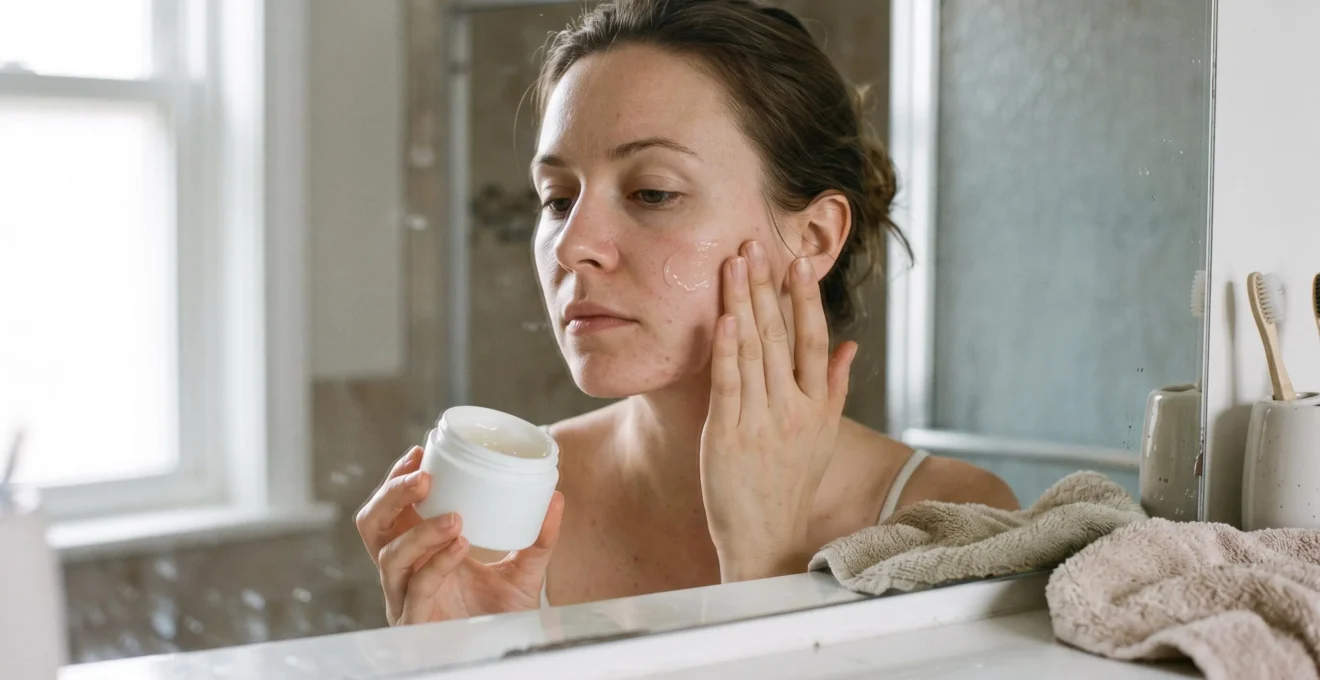
An enzyme peel can feel surprisingly comfortable while it is on your face, then leave your cheeks red, tight or unusually sensitive the following morning. This apparent contradiction is particularly frustrating when you have chosen enzymes because conventional exfoliating acids seem too harsh.
The explanation is that comfortable application does not guarantee irritation-free exfoliation. Enzymes can remove proteins associated with dead surface skin cells without producing an obvious stinging sensation. Your reaction also depends on the condition of your skin barrier, the complete formulation, contact time and any other active ingredients you use.
For sensitive skin, the aim is not to achieve the strongest possible exfoliation. It is to improve rough texture without creating inflammation that makes skin look and feel worse. Understanding when to use an enzyme peel, when to avoid one and how to recognise delayed irritation makes that balance easier to achieve.
Although enzyme peels may be marketed as gentle alternatives to acids, they are not automatically safer for every person. The most useful approach is to judge the individual product and your skin’s response rather than rely on the word « enzyme » on the packaging.
Enzyme peels and sensitive skin: the essentials
- Enzyme peels can cause redness even without immediate tingling. Product formulation, exposure and skin-barrier condition all influence tolerability.
- Patch-test new products, follow their instructions and avoid combining exfoliation with other potentially irritating actives.
- For smoother makeup, prioritise hydration and a settled skin barrier. Stop exfoliating if redness, burning or persistent sensitivity develops.
- Why Can an “Enzyme” Product Still Tingle if Your Skin Barrier Is Compromised?
- How to Use an Enzyme Peel at Home in 5 Steps Without Overdoing It?
- Enzyme Peel or Mild AHA: Which Gives Smoother Makeup Wear With Less Risk?
- The Timing Mistake That Turns a Gentle Enzyme Peel Into a Red Face
- When Should You Use an Enzyme Peel Before an Event to Avoid Surprise Irritation?
- How to Smooth Rough Texture Before Makeup Without Scrubbing or Stinging?
- PHA, Lactic, or Mandelic: Which Mild Acid Fits Sensitive Skin With Texture Concerns?
- Why Do Mild Acids Sometimes Cause More Breakouts in the First 2 Weeks?
Why Can an “Enzyme” Product Still Tingle if Your Skin Barrier Is Compromised?
An enzyme peel can sting compromised skin because its exfoliating activity occurs on a surface that is already irritated or less able to tolerate additional stress. Ingredients such as papain and bromelain break down proteins associated with surface exfoliation, but the finished product may also contain acids, fragrance or preservatives that contribute to irritation.
Enzyme exfoliation relies on proteolytic activity: enzymes act on proteins associated with the outermost skin surface. Papain, commonly associated with papaya, and bromelain, derived from pineapple, are among the enzymes investigated for cosmetic exfoliation.
A scientific review of proteolytic enzymes used for skin exfoliation identified potential exfoliating benefits alongside concerns about irritation and allergic reactions. It also highlighted formulation factors such as pH, temperature and enzyme stability.
11 articles
The scientific review identified 11 relevant publications, with relatively few clinical trials directly investigating enzymes as exfoliating agents. This limited evidence base does not establish that enzyme peels are universally gentler than acid exfoliants.
Scientific literature review indexed in PubMed.
When the skin barrier is compromised, ordinary products may produce sensations that previously went unnoticed. Dryness, inflammation and disruption of the outer skin layer can make additional exfoliation uncomfortable. However, there is insufficient direct evidence to claim that cosmetic enzymes routinely travel through microscopic cracks and digest living epidermal cells.
Before using a peel, check how your skin behaves during normal cleansing and moisturising:
- Tightness after cleansing: skin feels stretched or uncomfortable even after a mild wash.
- Stinging with simple products: plain water or a familiar moisturiser causes an unusual sensation.
- Visible flaking or inflamed patches: redness, peeling or soreness is already present.
Any persistent sign of irritation is a reason to postpone exfoliation. Experiencing two or more signs makes that decision particularly sensible, although this is a practical warning checklist rather than a clinically validated barrier test.
The ingredient list matters too. An enzyme mask may also contain lactic acid, glycolic acid, fragrance or other potentially irritating ingredients. Acids such as citric acid can serve as pH adjusters, so their presence does not automatically mean a product provides substantial acid exfoliation. An INCI list also cannot reveal the finished product’s exact pH or the concentration of every ingredient.
Mild, brief warmth is not necessarily proof of damage, but it is not something you need to tolerate. Persistent burning, increasing pain, visible irritation or swelling means the product should be removed immediately and not reapplied. Seek medical advice for severe or persistent symptoms.
When your skin tolerates basic cleansing and moisturising comfortably again, you can consider a cautious trial rather than trying to exfoliate through an active reaction.
How to Use an Enzyme Peel at Home in 5 Steps Without Overdoing It?
For sensitive skin, the safest starting approach is to test the product, use it only on calm skin, follow its specified contact time, remove it as directed and moisturise afterwards. Keep other exfoliants out of the same routine. The goal is controlled, occasional exfoliation, not the strongest possible immediate smoothing effect.
Start with a rinse-off enzyme product that provides clear instructions. Avoid experimenting with professional-strength peels, concentrated enzyme powders or products without reliable directions. A formula’s intended use matters because enzyme concentration, pH and stabilisation can vary substantially.
Before full-face application, follow the American Academy of Dermatology skincare product testing instructions. The general approach involves testing a small area over seven to ten days; rinse-off products should only be left on for their normal instructed exposure period.
A home test reduces uncertainty but does not guarantee that the entire face will tolerate the product.
For the first full-face trial, choose an evening when you have not used other exfoliants. Cleanse gently, pat the skin dry if the instructions specify dry application, and avoid applying the peel to freshly shaved, sunburnt or visibly irritated areas.
Contact time is an upper boundary, not a challenge to complete. Never exceed the manufacturer’s stated maximum. A shorter initial application may be reasonable when consistent with the product instructions, but there is no scientifically established universal first-use duration or reduction percentage for all enzyme peels.
Remove the product exactly as directed. Many rinse-off peels require lukewarm water; a separate neutralising product is only appropriate if the manufacturer specifically requires one. Follow with a familiar, fragrance-free moisturiser that your skin already tolerates.
Your five-step enzyme peel safety checklist
- Test first: complete a small-area tolerance test following the product’s intended use. Record the dates and any visible or sensory reactions.
- Prepare calm skin: choose a cleanse-only evening, confirm that the skin is not irritated and check whether the product requires dry or damp application. Record what else was used that day.
- Control exposure: set a timer within the manufacturer’s instructions and stop immediately if discomfort occurs. Record the actual contact time.
- Rinse and moisturise: remove the product as instructed, avoid additional exfoliants and apply a familiar plain moisturiser. Note any immediate redness or stinging.
- Review the result: compare photographs taken in similar natural light before treatment and over the following 72 hours. Record changes in redness, comfort and texture before deciding whether to repeat.
A 72-hour comparison is useful for noticing delayed changes, but the absence of symptoms during that period does not exclude every possible delayed allergic reaction.
Applying a peel on consecutive evenings, layering it with retinoids or adding another exfoliant before the skin has settled can increase irritation risk. Strong vitamin C formulations may also contribute to discomfort in some routines, although irritation depends on the particular formulation.
There is no fixed weekly frequency proven safe for every enzyme peel. Begin conservatively, respect the label and increase frequency only when your skin has demonstrated sustained tolerance.
Once application becomes predictable, the next question is whether enzymes actually offer an advantage over a mild acid for the texture you want to improve.
Enzyme Peel or Mild AHA: Which Gives Smoother Makeup Wear With Less Risk?
Neither enzyme peels nor mild alpha hydroxy acids are consistently proven to produce smoother makeup with less irritation across all sensitive skin types. Enzymes act through protein breakdown, while AHAs promote exfoliation through changes in the cohesion of surface skin cells. The gentler option depends on formulation, skin condition and frequency rather than the ingredient category alone.
Enzymes such as papain and bromelain support the removal of surface material through proteolytic activity. AHAs, including lactic acid and glycolic acid, encourage shedding of surface skin cells through a different chemical mechanism.
Enzymes are sometimes described as more surface-focused, but this does not establish a universal safety advantage. Similarly, a low-percentage AHA formula may be well tolerated by one person while a fragranced enzyme mask causes immediate discomfort in another.
The practical differences are best understood as considerations rather than guarantees.
| Consideration | Enzyme peel | Mild AHA |
|---|---|---|
| Exfoliating action | Proteolytic breakdown of proteins associated with surface exfoliation | Chemical promotion of surface cell shedding |
| Potential texture benefit | May reduce superficial roughness and flaky buildup | May improve surface roughness and uneven texture with appropriate use |
| Important risk factors | Enzyme activity, pH, fragrance, allergens and contact time | Acid type, concentration, pH, formulation and frequency |
| For highly reactive skin | Not automatically suitable; patch-testing is important | Not automatically unsuitable; tolerance is individual |
| Makeup outcome | May help when surface flakes are the main issue | May help when uneven shedding contributes to roughness |
For skin that becomes red or uncomfortable with ordinary products, neither option should be the immediate priority. Restore a comfortable basic routine before considering exfoliation.
For skin that is stable but persistently rough, a carefully selected enzyme product or low-strength AHA might be reasonable. People with rosacea, eczema or recurrent contact dermatitis should be particularly cautious and may benefit from professional advice before introducing either category.
Hydration is the shared variable that often matters most for foundation. Exfoliation cannot compensate for persistent dehydration. Skin with insufficient moisture may still show flakes and uneven makeup adhesion after dead surface cells have been removed.
Use a suitable moisturiser after exfoliating and allow the skin to settle before assessing whether foundation applies more evenly. Avoid judging performance immediately after rinsing, when temporary hydration may create a misleading impression of smoothness.
A simple weekly log can also prevent accidental overexfoliation. Count enzyme masks, AHA products, exfoliating toners and scrubs together rather than treating each category as an unrelated activity.
If you choose an enzyme peel, the next potential problem is not necessarily which ingredient it contains, but how long you leave it on.
The Timing Mistake That Turns a Gentle Enzyme Peel Into a Red Face
The timing mistake is leaving an enzyme peel on longer because it feels comfortable. Exfoliating activity does not necessarily produce immediate stinging, so sensation alone is an unreliable timer. Excessive contact can contribute to irritation, and redness or tightness may only become noticeable after the treatment has been removed.
Consider a familiar scenario: someone applies an enzyme mask, notices no discomfort and decides to leave it on beyond the recommended time. Their skin looks smooth immediately afterwards, but feels tight and appears red the next morning.
This is a hypothetical example, not evidence of a predictable reaction timeline. Nevertheless, it illustrates why immediate comfort should never be used as permission to extend exposure.
Enzyme activity depends partly on formulation conditions, including pH and temperature. The amount and stability of the enzyme also matter. A peel that works comfortably under one set of conditions may behave differently when applied to already irritated skin.
Warm bathrooms and steamy showers introduce additional uncertainty. Heat and humidity can affect the product environment, and heat itself can aggravate facial flushing in susceptible people. However, there is no established formula showing that shower warmth multiplies enzyme exposure by a specific amount.
Use the clock, not the tingle, to determine when to rinse. Do not extend the manufacturer’s contact time, even when there is no burning sensation.
Redness emerging the following day can have several explanations. Irritant reactions may develop after sufficient exposure, while some allergic contact reactions take longer to become apparent. Heat, friction, other skincare products and pre-existing inflammation can also contribute.
There is no scientifically established rule that enzyme-induced irritation must appear within 12–24 hours. Some reactions occur earlier, others later, and persistent symptoms require assessment rather than assumptions about timing.
If your skin becomes red or uncomfortable after a peel:
- Stop the peel and temporarily pause other potentially irritating skincare actives.
- Gently rinse away any remaining product using comfortably cool or lukewarm water.
- Apply a familiar bland moisturiser if your skin tolerates it.
- Avoid hot showers, facial scrubs and unnecessary friction while the irritation settles.
- Seek medical advice if redness is severe, worsening, painful, blistering or persistent.
A cool compress may provide temporary comfort. Do not apply ice directly to irritated facial skin.
Avoid reintroducing the same product automatically after a significant reaction. Recurrent or severe symptoms may indicate ingredient intolerance or contact allergy and warrant assessment by a healthcare professional.
That distinction becomes particularly important when exfoliation is intended to improve your appearance before a wedding, interview or another important event.
When Should You Use an Enzyme Peel Before an Event to Avoid Surprise Irritation?
Use an enzyme peel well before an important event rather than on the day itself. A new product should be tested in advance, and any full-face trial should leave sufficient time to observe delayed irritation. There is no universally safe number of days because individual reactions and recovery times vary.
Event preparation changes the risk calculation. Even temporary redness that would be manageable during an ordinary week can interfere with makeup or cause unnecessary discomfort on an important day.
The simplest approach is to distinguish between a product you already tolerate and one you have never used.
For a new product, start with a small-area tolerance test well ahead of the event. The AAD’s general skincare testing guidance describes a seven-to-ten-day testing period, which is a useful reminder that a single brief test cannot exclude every delayed reaction.
If the product is tolerated and there is sufficient time before the event, consider a full-face trial under ordinary conditions. Use the normal instructions, avoid combining it with other exfoliants and observe how your skin behaves over subsequent days.
Only consider another application before the event if your skin has remained comfortable and free from irritation. Someone with a history of delayed reactions may reasonably decide to avoid all elective exfoliation during the final days.
Never introduce a new enzyme peel on the morning of an important occasion. Same-day application provides no opportunity to assess delayed redness and may leave skin temporarily sensitive to primer, foundation or makeup removal.
Freshly exfoliated skin can also behave unpredictably under cosmetics. Foundation may cling to dry patches, while products can pill when incompatible layers or excessive amounts are applied. These outcomes are not unique to enzyme peels, and there is limited direct research comparing their effects on makeup wear.
Sun exposure deserves attention too. The FDA information on alpha hydroxy acids and skin safety describes evidence that AHAs can increase ultraviolet sensitivity. These findings should not automatically be attributed to enzyme-only peels, although daily sun protection remains sensible.
For outdoor events in the UK, check the UV index and use suitable broad-spectrum sunscreen. SPF 30 or higher is a practical minimum for routine facial protection, with appropriate reapplication during exposure. Avoid prolonged direct sun when skin is visibly irritated.
If your event is approaching and your skin is already flaky or sensitive, improving hydration is usually a more predictable strategy than introducing another exfoliating treatment.
How to Smooth Rough Texture Before Makeup Without Scrubbing or Stinging?
Rough texture before makeup does not always require exfoliation. Dehydration, visible flakes, uneven moisturiser application and product buildup can all interfere with foundation. For sensitive skin, gentle cleansing, hydration and a well-tolerated moisturiser are often better first steps than scrubs, brushes or last-minute peels.
The important distinction is between skin that feels rough because it lacks moisture and skin with persistent surface buildup or congestion.
Dry, flaky areas may look more pronounced under foundation because pigment collects around lifted skin edges. A moisturiser can soften their appearance without requiring immediate exfoliation.
For a low-friction makeup preparation routine, begin with a mild cleanser or simply rinse as appropriate for your skin. Avoid hot water and vigorous towel drying.
Next, apply a familiar hydrating product. A simple hydrating toner or essence is optional rather than essential, particularly when your moisturiser already provides adequate hydration.
Follow with a lightweight moisturiser suited to your skin. Allow it to settle before applying primer or foundation, and avoid excessive layering that can lead to pilling.
Choose makeup formulas that work together. Incompatible product textures, too much primer or repeated rubbing can cause visible rolling and patchiness even when the underlying skin is adequately hydrated.
Enzyme peels may have a role when superficial flaky buildup persists despite a consistent gentle routine. Unlike scrubs, they do not require abrasive particles or repeated mechanical rubbing to support surface exfoliation.
That distinction can matter for people whose skin becomes red after cleansing brushes or gritty scrubs. Nevertheless, the absence of mechanical friction does not mean an enzyme formula is automatically suitable for rosacea-prone or visibly inflamed skin.
Persistent small bumps may represent closed comedones rather than ordinary surface flakes. Retinoid-associated peeling, inflammatory skin conditions and certain forms of acne can also create uneven texture. Repeated surface exfoliation may not resolve these problems and can sometimes make irritation worse.
If roughness continues despite gentle cleansing and appropriate moisturising, reconsider the cause rather than increasing exfoliation frequency.
For persistent texture on otherwise stable skin, some people may consider a mild acid instead of an enzyme peel, but the type of acid deserves careful consideration.
PHA, Lactic, or Mandelic: Which Mild Acid Fits Sensitive Skin With Texture Concerns?
PHAs, lactic acid and mandelic acid offer different exfoliation characteristics, but none is automatically safe for sensitive skin. PHAs are often selected for gradual surface exfoliation, lactic acid for dry-feeling roughness and mandelic acid for uneven texture associated with blemish-prone skin. Concentration, pH and the complete formula are more important than ingredient names alone.
Polyhydroxy acids, or PHAs, include ingredients such as gluconolactone and lactobionic acid. Their relatively large molecular structures are often associated with more gradual surface activity, although the actual skin response depends on the finished product.
Lactic acid is an AHA that exfoliates while also having humectant properties. This combination can make it appealing in formulas designed for dry-feeling, rough skin, but it can still cause irritation when used too frequently or at an unsuitable concentration.
Mandelic acid is another AHA, with a larger molecular structure than glycolic acid. It is often marketed towards combination or blemish-prone skin, although molecule size alone does not establish how well an individual formula will be tolerated.
| Ingredient | Potential application | What to check |
|---|---|---|
| PHA | Gradual exfoliation when mild roughness and hydration are priorities | Other acids, fragrance and overall formulation |
| Lactic acid | Dry-feeling roughness and uneven surface shedding | Concentration, pH and frequency |
| Mandelic acid | Combination skin with blemish-associated texture | Additional actives, irritation history and tolerance |
These are orientation guidelines, not validated treatment assignments. A well-formulated lactic acid product may be better tolerated than a heavily fragranced PHA treatment, while another person may react to both.
It is also inaccurate to assume that an enzyme peel must always be the lowest-intensity starting point. Some enzyme formulations contain additional acids or other potentially irritating ingredients.
For highly reactive skin, the better starting point may be no exfoliating active at all until basic skincare feels comfortable.
If you decide to try an acid, introduce only one new exfoliating product at a time. Review the ingredient list for fragrance, alcohol denat, retinoids and additional exfoliating acids. None of these ingredients automatically makes a product unsuitable, but their presence can change the overall irritation potential.
Keep frequency conservative, monitor delayed reactions and avoid switching repeatedly between products before tolerance can be assessed.
Even a carefully selected mild acid can cause unexpected bumps or breakouts after introduction, making it important to distinguish possible adjustment from irritation.
Key takeaways before introducing a new exfoliant
- New bumps are not automatically evidence that exfoliation is working; irritation and unsuitable formulations are alternative explanations.
- Track where breakouts appear, whether they are painful and whether stinging, redness or tightness accompanies them.
- Introduce one exfoliant at a time and pause when symptoms worsen rather than increasing frequency to force results.
Why Do Mild Acids Sometimes Cause More Breakouts in the First 2 Weeks?
Mild acids can appear to cause more breakouts during the first two weeks because exfoliation changes surface skin shedding, an unsuitable formula may contribute to clogged pores, or irritation may produce acne-like bumps. Some people describe this as purging, but timing alone cannot confirm that explanation or prove the product is working.
The term « purging » is commonly used to describe blemishes that appear after starting products that influence skin-cell turnover. The proposed explanation is that pre-existing clogged pores become visible sooner.
However, the evidence does not establish a predictable two-week purging period for every mild acid, and an apparent breakout can have several unrelated causes.
A new moisturiser, sunscreen or exfoliant vehicle may contain ingredients that do not suit a person’s skin. Repeated application of multiple products can also make it difficult to identify which one is associated with the change.
Another possibility is irritation. Small red bumps, tightness, burning or worsening sensitivity after exfoliation may indicate that the skin is reacting poorly rather than undergoing a beneficial adjustment.
Look at the pattern rather than assuming every new spot is expected.
- Familiar congested areas: small blemishes appearing where clogged pores already occur may be consistent with existing acne becoming more noticeable, although the cause remains uncertain.
- Previously clear areas: a new widespread eruption raises concern about irritation or another reaction.
- Painful or deep lesions: these should not be dismissed as ordinary purging.
- Burning, itching or redness: accompanying barrier symptoms make irritation or allergy more concerning.
A simple product diary can help. Record the start date, application frequency, other skincare changes, locations of new blemishes and whether symptoms improve when the suspected product is stopped.
If bumps are mild, localised and unaccompanied by discomfort, observation may be reasonable, provided the routine remains conservative and the skin is otherwise tolerating the product.
But painful, spreading or inflamed breakouts are a reason to stop and reassess. Persistent, unusual or worsening symptoms should be discussed with a GP or dermatologist, especially if there is a history of acne or inflammatory skin disease.
Do not continue escalating exfoliation simply because a product is labelled mild. Increasing frequency can worsen irritation without resolving the underlying cause of the bumps.
This returns to the central lesson about enzyme peels: immediate sensation is only one part of the skin response. A product that feels gentle during application can still influence surface shedding and contribute to visible changes afterwards.
The practical next step is to keep your skincare routine simple, document the reaction and allow your skin to settle. If symptoms persist, seek professional advice rather than trying another exfoliant to correct the problem.
Can an enzyme peel cause an allergic reaction even if it contains natural ingredients?
Yes. Natural origin does not guarantee compatibility. Enzymes such as papain and bromelain, as well as fragrance and preservatives in the finished product, can be associated with adverse reactions. Itching, swelling or persistent redness after application may warrant evaluation for contact allergy or another skin reaction.
How long should redness after an enzyme peel last?
There is no reliable universal duration. Mild temporary flushing may settle relatively quickly, whereas irritation or allergic contact dermatitis may last longer. Redness that worsens, becomes painful, blisters or fails to improve should be assessed by a healthcare professional. Do not repeat the peel while skin remains irritated.
Can an enzyme peel be used while taking prescription acne medication?
Ask your prescribing clinician or pharmacist before adding exfoliation. Prescription retinoids and some acne treatments can increase dryness or irritation, and the suitability of a peel depends on the medication, the formulation and your skin condition. Do not stop or change prescribed treatment solely to accommodate a cosmetic peel without professional guidance.
Is an enzyme peel necessary for a smoother-looking complexion?
No. Gentle cleansing, appropriate moisturising, consistent sun protection and suitable makeup products may be sufficient to improve the appearance of surface dryness and uneven application. Exfoliation is optional, particularly when skin is already reactive or recovering from irritation.
Should you use an enzyme peel if your skin is sunburnt or peeling?
No. Sunburnt, peeling or visibly inflamed skin should not undergo elective exfoliation. Avoid additional irritation, use gentle supportive skincare and allow the skin to recover. Seek medical advice for severe sunburn, significant blistering or symptoms of illness.