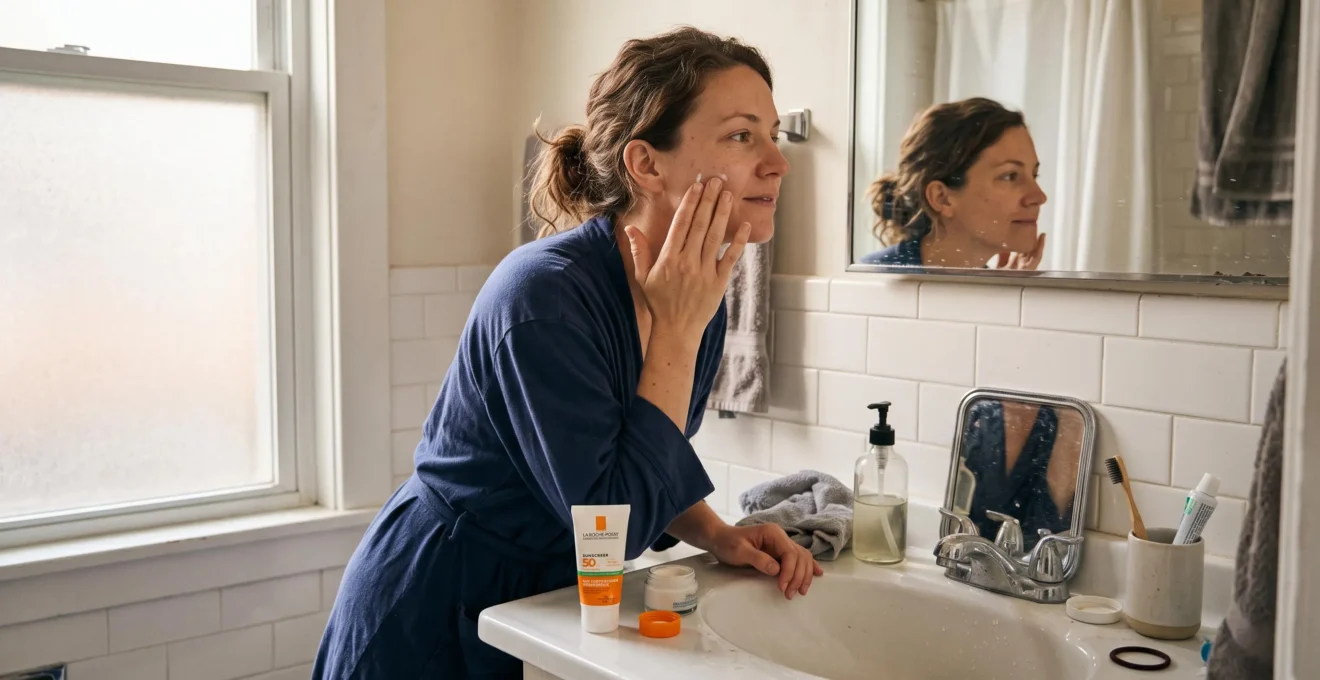
Self-care can start feeling like another full-time job after 30 when looking after yourself becomes a series of decisions, purchases and expectations rather than a source of comfort. Between work commitments, social responsibilities and changing skin needs, even a supposedly relaxing skincare routine can become one more thing to complete correctly.
The pressure often comes from a familiar contradiction. Beauty advice encourages consistency while continuously introducing new products, techniques and ingredients. A routine that initially feels reassuring can gradually become difficult to maintain, especially when missing a step produces guilt rather than relief.
There is a more sustainable approach. Effective everyday skincare does not automatically require numerous products, and a meaningful self-care ritual does not need an elaborate schedule. The objective is to protect your skin, make space for enjoyment and establish habits that remain manageable during ordinary working weeks.
For busy professionals, that means choosing a dependable foundation, treating additional steps as optional and recognising that a routine should accommodate real life rather than compete with it.
Self-care without the second-job feeling
- Build everyday skincare around essential cleansing, moisturising and appropriate sun protection rather than an expanding product checklist.
- Use a simple weekday routine and reserve longer rituals for moments when they genuinely feel restorative.
- Review your routine weekly, change products deliberately and treat reduced-effort days as part of consistency, not failure.
- Why a 10-Step Routine Can Feel More Stressful After Two Weeks
- How to Build a 7-Minute Morning Routine on Workdays Without Skipping the Basics
- Minimal Routine or Ritual Routine: Which One Fits a Busy Week Without Burnout?
- The Retail-Therapy Trap That Leaves You With 6 Half-Used Products and No Results
- A Simple Weekly Reset That Keeps Your Routine Consistent Even During Stressful Weeks
- Why Can a Product Stop Working After Around a Month Even if You Didn’t Change Anything?
- Why Can City Air Trigger Redness Even if You Don’t Have Sensitive Skin?
- Why Does Your Skin Suddenly Hate Products You’ve Used for Months?
Why a 10-Step Routine Can Feel More Stressful After Two Weeks
A ten-step skincare routine can become more stressful after two weeks because every additional product introduces another action to remember, sequence and evaluate. What originally felt enjoyable may gradually resemble a compulsory checklist. The problem is not necessarily the number of products: it is whether the routine demands more attention and energy than it returns.
At first, a new regimen often benefits from novelty. Choosing a serum or learning an application technique can feel interesting. Once the novelty fades, however, the same steps still require time, particularly when they involve waiting, checking ingredient combinations or deciding which treatment belongs on which evening.
There is an important distinction between routine length and routine friction. Someone may enjoy ten familiar steps performed comfortably, while another person finds three poorly organised steps irritating. The useful question is not simply how many products are on the shelf, but how frequently the routine interrupts your attention.
A practical self-check involves noticing three behaviours:
- Do you skip different steps each day because you cannot remember what comes next?
- Do you feel guilty when the routine is shorter, even when your skin feels comfortable?
- Do you add extra treatments the following day to compensate for something you missed?
These are possible signs of a poorly matched routine rather than evidence that you lack discipline. The third behaviour can create a particularly unhelpful cycle: missed steps prompt compensatory effort, which makes the next session feel more demanding.
The American Academy of Dermatology’s skin care on a budget recommendations describe cleansing, moisturising and sun protection as a practical foundation. The guidance also warns that using numerous skincare products can increase costs and irritation. It does not, however, establish that ten-step routines cause psychological stress.
Nor is routine fatigue an inevitable biological consequence of turning 30. More often, the relevant issue is the relationship between competing demands, personal expectations and available time.
Once those friction points are visible, the next step is to design a routine that works even on a rushed Monday morning.
How to Build a 7-Minute Morning Routine on Workdays Without Skipping the Basics
A seven-minute morning skincare routine is possible for many people when it prioritises gentle cleansing as needed, moisturising and appropriate sunscreen application. The key is deciding in advance which steps are essential and which can wait. Seven minutes is a practical scheduling target, not a medically established ideal, and sun protection should never be compromised to meet it.
Start by separating steps according to their purpose. Sunscreen offers protection against ultraviolet exposure, while moisturiser helps maintain hydration and supports comfortable skin. Additional serums and cosmetic treatments may address particular concerns, but they do not all need to fit into a weekday morning.
A possible seven-minute structure looks like this:
- Minutes 0–2: Gently cleanse if needed and pat the skin dry. A morning water rinse may suit some people, depending on their skin and evening routine.
- Minutes 2–3: Apply moisturiser where needed, or use an appropriate combined moisturiser and sunscreen product.
- Minutes 3–5: Apply broad-spectrum SPF 30 or higher generously and evenly to exposed skin, following the product’s directions. Do not reduce the recommended amount to save time.
- Minutes 5–7: Allow time for any product-specific application instructions and prepare for the day without introducing unnecessary extra steps.
The precise timing will vary with product texture, individual skin needs and how much exposed skin requires protection. Sunscreen also needs reapplication according to exposure and product guidance, particularly during prolonged outdoor activity.
It helps to establish a minimum viable routine the previous evening. Put the essentials together and remove the decision about which active ingredient, exfoliant or mask deserves attention tomorrow.
A two-tier system makes the distinction clear: weekdays have a predictable core, while weekends can accommodate optional treatments or a longer, more enjoyable ritual. This is an organisational strategy rather than a dermatological requirement.
Importantly, specific medical treatments prescribed for skin conditions should not be removed merely to meet an arbitrary time limit. Their instructions take priority over a simplified beauty schedule.
The routine should feel easy enough to repeat, not so rigid that an unexpected early meeting makes it impossible. Once the basics are established, enjoyment can become a choice rather than an obligation.
Minimal Routine or Ritual Routine: Which One Fits a Busy Week Without Burnout?
A minimal skincare routine is usually better when time and mental energy are limited, while a ritual routine may suit moments when you want relaxation and deliberate personal attention. Neither approach is inherently superior. The most sustainable choice depends on whether your immediate need is practical consistency, emotional enjoyment or a combination of both.
Minimalism and ritual are sometimes treated as opposites, but they describe different aspects of self-care. Minimalism concerns the amount of effort involved; ritual concerns how attention and meaning are brought to an activity.
One carefully applied moisturiser can become a brief personal ritual. Conversely, a collection of supposedly essential minimalist products can feel exhausting when each requires a separate decision.
The following comparison can help identify the right approach for a particular week.
| Decision factor | Minimal routine | Ritual routine |
|---|---|---|
| Main purpose | Maintain practical consistency | Create a moment of enjoyment or calm |
| Time commitment | Usually short and predictable | Flexible, depending on preference |
| Best fit | Busy workdays and low-energy evenings | Unhurried moments with room for attention |
| Early warning sign | Feeling joyless or overly mechanical | Feeling obliged to complete every element |
| Useful adjustment | Add one enjoyable sensory detail | Remove any step that feels compulsory |
A hybrid approach can work especially well. Imagine a hypothetical office worker who keeps the same straightforward skincare routine from Monday to Friday but enjoys taking a little extra time on Sunday evening to massage in moisturiser while listening to music.
The Sunday routine does not need more active ingredients to qualify as meaningful self-care. Its purpose is the experience, not additional cosmetic performance.
Behavioural research provides some context. Lally and colleagues’ study on habit formation examined repeated everyday behaviours and found that consistency of context was associated with increasing automaticity. It did not specifically investigate beauty routines or compare minimalist care with mindful rituals.
18–254 days
The estimated range for participants to approach 95% of their modelled habit automaticity in the Lally study. The wide variation demonstrates why habit formation should not be treated as a fixed deadline; skincare routines were not tested.
Lally and colleagues, European Journal of Social Psychology.
This distinction matters because attempting to turn every skincare session into a restorative experience can itself become exhausting. Some evenings, straightforward maintenance is enough.
When enjoyment becomes optional rather than mandatory, there is less temptation to compensate for an uninspiring routine by constantly buying something new.
The Retail-Therapy Trap That Leaves You With 6 Half-Used Products and No Results
Having six half-used skincare products does not necessarily mean none of them works. Frequent switching can make it difficult to judge results because products may need different observation periods and address different concerns. Shopping offers an immediate feeling of progress, but purchasing another formula cannot replace the consistent use needed to evaluate many skincare benefits.
The pattern often begins with understandable frustration. A moisturiser feels ordinary after a few weeks. A new serum promises a more targeted solution. Another product appears in a recommendation video, and the original products gradually move to the back of the shelf.
Eventually, the collection grows while confidence in the routine declines. The difficulty is partly methodological: when several variables change together, it becomes harder to know what caused an improvement, an irritation or no noticeable difference.
Consider the one-variable rule. When trialling a new optional product, avoid introducing several others simultaneously. Note the date, the concern being addressed and what you intend to observe. Choose an assessment period that suits the product and its claims rather than assuming every ingredient should produce results within a month.
There is one essential exception: if a product causes concerning irritation or a suspected allergic reaction, do not keep applying it just to complete an experiment. Stop the suspected product and seek appropriate advice when symptoms warrant it.
Before buying anything else, conduct a simple shelf audit. Divide products into three categories:
- Keep using: Products that are suitable, within their usable life and already fulfil a clear purpose.
- Pause: Optional products that complicate the routine or make it difficult to assess another treatment.
- Let go: Products that have expired, deteriorated or repeatedly caused problems. Follow appropriate disposal guidance.
Finishing suitable products before replacing them can reduce waste and unnecessary spending. However, there is no benefit in finishing something that your skin does not tolerate.
The emotional question is equally useful: are you buying because you have identified an unmet need, or because a new product feels easier than maintaining the current routine?
A stable collection makes it easier to notice what your skin needs. The remaining challenge is preserving that simplicity when your working week becomes unpredictable.
A Simple Weekly Reset That Keeps Your Routine Consistent Even During Stressful Weeks
A weekly skincare reset can support consistency by giving you a short, predictable opportunity to simplify your routine before the next busy week begins. Instead of expecting identical effort every day, choose an everyday version and a reduced version in advance. This makes occasional disruption part of the plan rather than evidence that the routine has failed.
The reset need not involve a complicated spreadsheet or detailed product diary. Set aside approximately ten to fifteen minutes at a convenient point in the week. The timing is an organisational suggestion, not a scientifically validated requirement.
Review what happened in practical terms. If cleansing felt burdensome late at night, perhaps your products were inconveniently stored. If morning sunscreen application was rushed, perhaps everything else took priority because the routine included too many optional steps.
The aim is to identify obstacles rather than judge your motivation.
A useful technique is planned downshifting: your reduced routine maintains the appropriate basics, while optional treatments wait until you have more capacity. The precise steps still depend on your skin, environmental exposure and any prescribed treatment.
Your five-action weekly skincare reset
- Review the previous week and write down one recurring obstacle, such as rushed mornings or forgotten products.
- Choose your normal weekday routine and record the essential steps in a single short note.
- Define a reduced routine for especially busy days and write it beneath the normal version.
- Check your supplies, expiry information and product placement; produce a short list containing only genuinely necessary replacements.
- Mark each completed routine as either « done » or « reduced », creating a simple record without tracking individual steps.
This two-state tracking method is a proposed low-pressure alternative, not a technique proven superior in clinical trials. If any form of tracking increases anxiety, it is reasonable to abandon it.
The wider habit-formation research discussed earlier also offers a reassuring qualification: in the Lally study, missing one opportunity did not materially disrupt habit formation. That finding concerns everyday behaviours rather than skincare specifically, and does not mean regular repetition is irrelevant.
The purpose is to keep a useful routine available during difficult periods. It is also worth remembering that some apparent failures of consistency are simply changes in how skin responds over time.
Why Can a Product Stop Working After Around a Month Even if You Didn’t Change Anything?
A skincare product may appear to stop working after around a month because its initial visible benefits have become less noticeable, your skin’s needs have changed or your expectations have shifted. This does not automatically indicate that the formula has lost effectiveness. Different ingredients also produce results over different periods, so four weeks is not a universal assessment deadline.
One explanation is that early improvements are easier to see than continued maintenance. A moisturiser may make dehydrated skin feel more comfortable relatively quickly. Once hydration improves, there may be less visible change to notice, even though the product continues to fulfil its purpose.
Other cosmetic goals, such as improving uneven pigmentation or skin texture, often require a different assessment period. The appropriate timeline depends on the ingredients, condition being addressed and individual response.
Before replacing a product, compare what you see today with a reasonable baseline:
- Identify the original concern, such as dryness, roughness or uneven appearance.
- Review any dated notes or photographs taken in consistent lighting.
- Consider whether your expectations match the product’s intended purpose.
- Check for changes in weather, indoor heating, air conditioning, sleep or other aspects of your routine.
These contextual factors can coincide with changes in skin comfort or appearance. They should be treated as possible explanations rather than assumed causes.
It is also important to distinguish a plateau from a genuine problem. If a moisturiser keeps your skin comfortable, the absence of further visible improvement may be perfectly acceptable. If a product now causes irritation, or no longer addresses your needs, reassessment is more appropriate.
Rotating active ingredients simply because a calendar month has passed can create unnecessary complexity. It also makes subsequent changes harder to interpret.
For persistent concerns, particularly those involving a medical skin condition, a pharmacist, GP or dermatologist can help determine whether the product and expectations are appropriate.
Skin behaviour does not remain constant simply because the products on your bathroom shelf do. Environmental exposure is one reason an otherwise familiar routine may need adjusting.
Why Can City Air Trigger Redness Even if You Don’t Have Sensitive Skin?
City air may contribute to skin irritation or redness through exposure to pollutants, including particulate matter and ozone, which can be associated with oxidative stress and skin-barrier disruption. However, redness after a commute does not prove that pollution caused it. Weather, temperature changes, skincare products and underlying conditions may also explain the reaction.
Urban environments expose skin to a mixture of external influences rather than one isolated pollutant. Traffic emissions, airborne particles, changing temperatures and indoor climate conditions can overlap during a typical working day.
The biological mechanisms linking environmental pollution with skin changes are plausible, but evidence about individual symptoms is more uncertain than some beauty marketing suggests.
A 2026 systematic review of air pollution and skin diseases evaluated epidemiological research covering several pollutants and dermatological outcomes. The authors identified adverse associations in numerous studies but considered the overall certainty of causal evidence generally low or very low.
77 studies
The number of studies included in the 2026 systematic review after screening 1,393 records. The review examined associations between ambient air pollution and skin diseases, not whether pollution reliably causes facial redness in otherwise unaffected individuals.
Singh, Schikowski and Krutmann, American Journal of Clinical Dermatology, 2026.
This distinction matters when deciding how to respond. Brief redness following an outdoor journey may be associated with several exposures. Persistent burning, recurring rashes or increasing discomfort deserve a more careful assessment rather than being labelled an ordinary pollution reaction.
A proportionate routine remains straightforward:
- Use a suitable moisturiser to support comfortable, hydrated skin.
- Cleanse gently when needed, particularly after substantial exposure to dirt, sweat or environmental debris.
- Maintain appropriate UV protection with sunscreen, without assuming that sunscreen alone blocks all pollution-related effects.
- Avoid introducing several new anti-pollution products simultaneously.
The goal is not to eliminate every possible exposure through skincare. It is to respond to your circumstances while avoiding unnecessary irritation and product overload.
Someone commuting through a busy city may need different practical habits from someone working indoors, but neither situation automatically requires an elaborate routine.
When sensitivity becomes persistent or familiar products begin causing discomfort, however, the question shifts from environmental maintenance to identifying the actual trigger.
Key takeaways before changing your products
- A familiar formula becoming uncomfortable is a reason to investigate, not proof that an entire skincare routine is unsuitable.
- Consider recent product additions, changes in skin condition and exposure before assuming that a long-used ingredient is responsible.
- Persistent or recurring irritation deserves professional assessment, especially when simple changes do not help.
Why Does Your Skin Suddenly Hate Products You’ve Used for Months?
Skin can suddenly react to products used comfortably for months because its barrier condition has changed, a product has been reformulated or a new contact allergy has developed. Changes in product storage, age or combinations may also matter. A familiar product is not guaranteed to remain suitable indefinitely, and the precise cause cannot be established from timing alone.
One possible explanation is a temporary change in skin-barrier function. Excessive exfoliation, harsh cleansing or environmental conditions may leave skin feeling more vulnerable to products that previously seemed comfortable.
Another possibility is contact dermatitis. Importantly, a delayed allergic reaction can develop even after repeated exposure to a previously tolerated ingredient.
The American Academy of Dermatology’s patient guidance on contact dermatitis notes that reactions can occur to products used for years. It also identifies product reformulation as a possible explanation, while recommending appropriate specialist assessment for persistent, recurrent or troublesome symptoms.
When a reaction appears, begin by considering what has changed. That may include:
- A recently introduced serum, exfoliant or other active treatment.
- More frequent application or a different combination of products.
- A changed ingredient list or newly purchased version of a familiar product.
- A product that has exceeded its recommended period after opening or shows signs of deterioration.
- A recent change in cleansing habits or environmental conditions.
A sensible first response is to stop applying a product that appears to provoke irritation. Where appropriate, temporarily simplify non-essential skincare and avoid introducing additional active treatments while the skin settles.
For mild, uncomplicated irritation, a gentle cleanser and suitable fragrance-free moisturiser may be more comfortable than a complex routine. However, a suspected allergy should not be tested repeatedly on the face simply to identify the culprit.
Reintroducing products one at a time may be useful after a non-allergic episode has resolved, but suspected allergic reactions require more caution. A dermatologist may recommend formal patch testing rather than home experimentation.
Seek clinical advice for persistent, recurring, blistering or particularly uncomfortable rashes. Severe swelling, breathing difficulty or other signs of a serious allergic reaction require urgent medical attention.
The broader lesson is that a change in skin tolerance does not automatically justify replacing every product. Sometimes the right adjustment is smaller: stop one suspect treatment, review the routine, check the product information and obtain advice when needed.
For your next ordinary working day, choose the simplest suitable routine that keeps your skin comfortable and protected. Keep additional treatments optional, and allow the routine to change when your needs genuinely change. Sustainable self-care is not about completing every possible step; it is about making appropriate care easier to live with.
Is it normal to feel guilty about skipping a skincare routine?
Feeling guilty can happen when skincare becomes associated with strict personal expectations. An occasional missed cosmetic step does not mean you have failed at self-care. A simpler routine and more flexible expectations may help, although essential protection and medically prescribed treatments still deserve appropriate attention.
Can a skincare routine be effective without expensive products?
Yes. Everyday skincare does not necessarily require premium products or numerous active ingredients. Gentle cleansing, moisturising and suitable sunscreen form a practical foundation for many people. Specific skin conditions may require additional treatments, but higher prices or more elaborate routines do not automatically guarantee better results.
Should your skincare routine change when you turn 30?
There is no universal requirement to overhaul skincare at 30. Adjustments should reflect your current skin concerns, tolerance, lifestyle and sun exposure rather than an arbitrary birthday. Maintaining suitable basics may be more useful than introducing a large collection of age-targeted products.
How can you tell whether self-care is helping your wellbeing?
Consider whether the activity leaves you feeling comfortable, supported or pleasantly engaged without creating disproportionate pressure. If your routine consistently causes anxiety, demands unwanted spending or interferes with rest, reducing its complexity may be worthwhile. Enjoyment is a valid reason to keep an optional ritual, but it should not become compulsory.
Do you need to track your skincare routine every day?
No. Tracking is optional. A brief note can help when introducing a product or investigating a reaction, but everyday skincare does not require continuous monitoring. If detailed tracking makes the routine feel like additional work, a simple weekly review or no tracking at all may be more suitable.